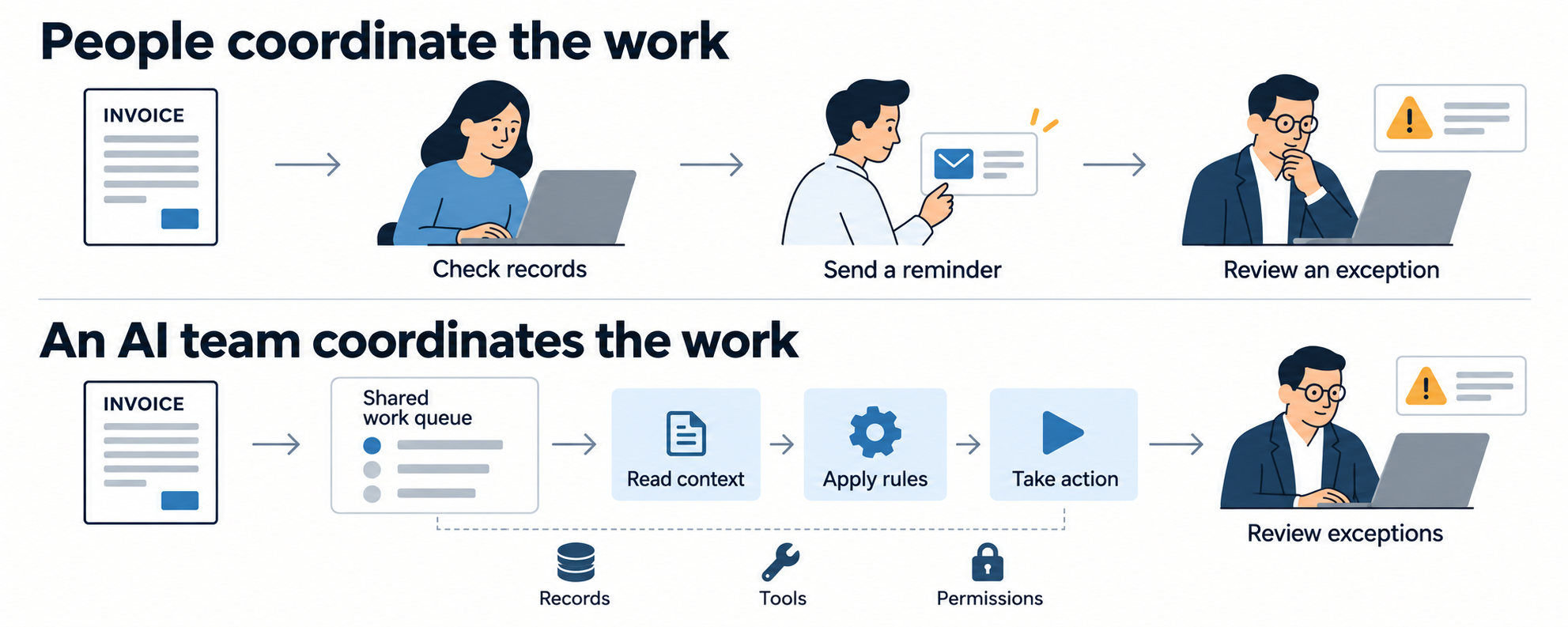
Shared context, clear responsibilities, and authority to act change what a business system can be.
The same question keeps coming up in my conversations: is SaaS dead in the age of AI?
I think the question points at the wrong layer. The needs that business software serves are not going away. Invoices still have to be collected, and records still have to be kept. What may change is who does the work around the software, and therefore what the product actually is.
My working view is that the unit of a business product is beginning to shift. Instead of an application that people operate, we can build a team that carries a process through: roles with shared context, clear authority, and a record of what was done and why. Agents fill some roles; people fill others.
The product may still be sold as a subscription and run in the cloud. What changes is what the customer expects it to do.
Who does the operating
In much of business software, the division of labor is familiar. Software stores records and enforces rules. People do the coordinating. They read the screen, decide what it means, move information between tools, and chase whoever needs chasing.
Take a hypothetical invoice that is thirty days past due. Someone in finance spots it on an aging report. They check payment history in the billing system and look in the CRM for the account manager's notes. Then they send a reminder, log the contact, and perhaps message someone in sales. Several applications are involved, but the workflow itself lives in the person moving between them.
Software already automates plenty of these steps. What interests me is the work between the steps: interpreting a note, finding the relevant context, deciding which role should act next, and recognizing when the usual procedure does not fit.
When agents take on that coordinating work, the executor and the system begin to overlap. A collections role that reads records, applies policy, acts through approved tools, and reports back is part of the workforce and part of the business system at once.
Building the team becomes a way of building the system.
A team, not a pile of chatbots
A handful of chat assistants, each with a partial view, can reproduce the copy-and-paste problem faster. An organization needs a shared view of customers and their history, distinct responsibilities, access to tools, and clear limits on what each role may do. It also needs to remember what happened and deliberately revise how it works.
This changes where a role lives. Rather than every employee keeping a private assistant that half-knows the finance process, the organization can maintain a shared collections role. Different people can hand work to it. It can hand work back to them, or to another role, when the next step falls outside its authority.
For our overdue invoice, a policy might allow the collections agent to send reminders on an approved schedule using approved templates. It cannot change payment terms or write off debt. A dispute or an escalation that could affect the customer relationship goes to a named person, with the available history already gathered.
The useful difference is not just that a message gets written faster. Someone no longer has to reconstruct the process and carry it across three applications every time.
The records still matter
The billing system remains the system of record. Sending an email or updating an account still requires reliable tools, explicit permissions, and a way to check the result. Exceptions need an owner. Accountability for a financial decision still rests with a person.
What the AI team adds is coordination across those pieces. In a well-designed system, each reminder is logged with the invoice it concerned, the policy that authorized it, and the information it relied on. Each escalation records who decided, what they decided, and why.
A finance lead should be able to reconstruct a month of collections activity without asking everyone to remember it. The operating record is part of the product.
Corrections don't teach themselves
It is tempting to say that know-how now lives in the organization and keeps pace with the business. It can, but not on its own. A correction in one conversation does not, by itself, update how the whole organization works.
Suppose the finance lead stops a reminder because the invoice is under dispute. That fixes one case. It becomes durable know-how only when the correction is written back into the way the team operates: an updated rule for disputed invoices, a checked note about this account, and a test that verifies the rule before another reminder goes out.
Traditional software captures know-how too, in code and configuration. Agents do not make maintenance disappear. They give us another place to express and revise the operating logic: shared instructions, role definitions, policies, and examples that can be inspected and tested alongside the code.
When a workflow changes from four people to two, the question becomes which responsibilities, permissions, and handoffs need to change. Some changes will still require engineering. Others can be made by revising how the team works.
What compounds is the organization's ability to carry a process through—and the knowledge of when the usual process is wrong. That knowledge should survive a change of employee or model. A better model is useful; a team that can retain and apply its experience is a different kind of asset.
Screens for judgment
Many dashboards exist to prompt someone to act: this customer is overdue, go do something. If the routine action is already handled within policy, people no longer need to visit that screen to keep the process moving.
They still need interfaces for judgment and intervention. What needs a decision? What has already happened? Why did the agent act? Can I pause it, correct it, or change the rule? They also need to see whether the process is working overall, including the cases that never triggered an alert.
Attention remains scarce. The interface should help people spend it where their judgment matters.
The candle and the lightbulb answered the same need: light the room. Business processes still have to be managed, carried out, and remembered. AI gives us a different way to organize that work.
For me, this is the useful question beyond “Is SaaS dead?”: when an AI team can coordinate and execute a business process, how much of the system are we already building by designing that team?
Designing the organization and designing the system are starting to become the same job.